lunes, 21 de marzo de 2011

PIAGET`S STAGES OF COGNITIVE DEVELOPMENT

Characteristics of the Preoperational Stage
The preoperational stage occurs between ages two and six. Language development is one of the hallmarks of this period. Piaget noted that children in this stage do not yet understand concrete logic, cannot mentally manipulate information, and are unable to take the point of view of other people, which he termed egocentrism.
During the preoperational stage, children also become increasingly adept at using symbols, as evidenced by the increase in playing and pretending. For example, a child is able to use an object to represent something else, such as pretending a broom is a horse. Role playing also becomes important during the preoperational stage. Children often play the roles of "mommy," "daddy," "doctor" and many others.


Egocentrism:
Piaget used a number of creative and clever techniques to study the mental abilities of children. One of the famous techniques egocentrism involved using a three-dimensional display of a mountain scene. Children are asked to choose a picture that showed the scene they had observed. Most children are able to do this with little difficulty. Next, children are asked to select a picture showing what someone else would have observed when looking at the mountain from a different viewpoint.
Invariably, children almost always choose the scene showing their own view of the mountain scene. According to Piaget, children experience this difficulty because they are unable to take on another person's perspective.

Conservation:
Another well-known experiment involves demonstrating a child's understanding ofconservation. In one conservation experiment, equal amounts of liquid are poured into two identical containers. The liquid in one container is then poured into a different shaped cup, such as a tall and thin cup, or a short and wide cup. Children are then asked which cup holds the most liquid. Despite seeing that the liquid amounts were equal, children almost always choose the cup that appears fuller.
Piaget conducted a number of similar experiments on conservation of number, length, mass, weight, volume, and quantity. Piaget found that few children showed any understanding of conservation prior to the age of five.

THE BENEFITS OF PRESCHOOL

The chance to interact with other children is the benefit of preschool in a nutshell but it is far more than what those few words say. You are so wise to pursue more information when you feel that the obvious may not be all there is to know.
Interacting with other children means learning how to wait, how to take turns, and how to listen. Young children learn social skills when they interact with other children. These social skills are critical to a developing personality and I would not dismiss them lightly.
There are other advantages to preschools -- primarily that they are the foundations for academic learning. In preschool your child will listen to poetry and songs -- building blocks needed to grasp phonics and reading skills when it is developmentally appropriate. The play that takes place with water, sand, and containers form the foundation for understanding some basic math concepts. Matching, sequencing, one-to-one correspondence are all activities that are done over and over in preschool settings and help children get ready to learn academics. Watching other children pursue a challenging task is also helpful. The presence of other children and a wide variety of materials are two big reasons why a preschool is a good thing.
I believe preschool is beneficial and can do many things that will help children be successful when formal school begins. I also feel that there are many schools that are advertised as preschools that are not beneficial, and it requires a concerned parent to interview and observe before placing their child.


domingo, 20 de marzo de 2011

STAGES OF CHILDREN`S SOCIAL DEVELOPMENT


Childhood friendships provide kids with much more than just people to play with. Learning to make friends as well as learning to be a good friend are important parts of a child's social development skills that will help them to find success in both their personal and professional lives.

First Friends
For their first few years, most children are exposed largely to family members and close family friends. Being on the receiving end of the unconditional love and acceptance that family provides gives children a solid base of confidence and self-esteem from which they are able to build further social attachments. Often, a child's very first friends are the children that they meet at preschool.

Learning Through Play
Most of the learning that young children do is through play, and building social competence is no different. Typically, 2-3 year olds will initially play side-by-side, rather than directly with one another, but as they observe each other and become comfortable, the little ones will begin to interact and share toys. By preschool, kids become even more interactive, engaging each other in simple conversation. They will talk about the things that they did after school or on the weekend and respond positively to the stories of their friends. This give-and-take is a great step in social development as they work from being self-focused to other-focused.

Looking Out for One Another
As friendships develop, kids become increasingly aware of the feelings of other people, expressing happiness when their friends are happy and showing empathy for a friend's hurt feelings. They will also seek out their similarities, instinctively knowing that sharing common bonds is important to maintaining friendships. They'll focus on favourite colours, foods, or games, and delight in the fact that they are alike in many ways. Another common development as friendship capacity develops is a child's desire to protect their friends. Friends stick together, and that lesson comes to most children during their school years as one friend goes through a difficulty and another's instinct is to stand up for their troubled friend. Further bonded by their common experience, their loyalty to the friendship deepens.

Erik Erikson and Psychosocial Development
Erik Erikson believed that people were constantly developing socially, from birth throughout all of life. He further believed that successful mastery of each step was necessary before moving on to the next, so if someone stalled out at a certain level, working through the rest would be impacted in a negative way. He divided his set phases of psychosocial development into eight distinct stages, the first five going from infancy through adolescence. Those first five steps are:

Trust vs. Mistrust (Birth to 1 Year)
Primary caregivers are responsible for seeing that the needs of young babies are met lovingly and consistently to help establish a feeling in the baby that the world is a safe and welcoming place.

Autonomy vs. Shame and Doubt (1 to 3 Years)
Parents and caregivers should encourage and celebrate the emerging independence displayed during this phase in order to build a child's self-confidence.

Initiative vs. Guilt (3 to 6 Years)
As kids become more assertive, reach out to others for friendship, and begin to explore their individuality, it is important that they be supported in their efforts, lest they feel inept and begin to mistrust their own abilities.

Industry vs. Inferiority (6 Years to Puberty)
School experiences come to the forefront, with children taking pride in planning and executing projects. The encouragement of parents and caring educators helps to build a child's sense of self-esteem, furthering their confidence and ability to interact positively in the world.

Identity vs. Role Confusion (Adolescence) 
At the threshold of adulthood, teens are faced with a number of important decisions about their futures. If they have built a solid base, they will have an easier time determining just what their place in the world should be.


Points to Ponder
While each child will develop social proficiency at their own rate, there are some seemingly universal truths to social development:
  • Preschool friendships are typically the first "give and take" relationships that kids have outside of their homes.
  • Children aged 3-5 often have imaginary friends, which is perfectly normal and need not be a source of concern for parents.
  • Early friendships are based more on circumstance (i.e. classmates, neighbours, attendees of the same play group, etc) than on genuine similarities.
  • Kids tend to have a "best friend" throughout their school years, but in the early years, that best friend is likely to change several times.
  • Most childhood friendships are between children of the same gender, with whom most kids feel that they have the most in common.
  • Friendships are usually of high importance to children, especially in late childhood and adolescence, helping kids to strengthen their social abilities.


STORYTELLING WITH CHILDREN


Grandparents are usually great at storytelling,young children are often captivated by the things they learn never quite knowing if the story is true or not especially if it is wildly different from their everyday lives. Unfortunately today children don’t see their grandparents as often they would like, due to distance or separation and kids can miss out on that vital connection.
A lovely way to connect with your child is to read a story together that touches on a topic or feeling that they can identify with. When your child is acting out in a negative or challenging manner it could be because they are struggling with something they feel they can’t discuss with you, or simply can voice exactly what is upsetting them. If there’s a behaviour that needs some adjustment, then approaching it indirectly through story time can be really helpful, particularly for children who are sensitive to correction or feel singled out.
With young children, creating a story about a child who has the same problem as them, but a different name, allows you to talk about the issues and emotions without pointing the finger. Kids love being given the chance to solve a problem for themselves, using a story is a safe and effective way to do just that and will help build their self-esteem too.

ENCOURAGING SECURITY IN A YOUNG CHILD

All children have fears. Anxiety and fear are normal emotions, but they make a child feel very unhappy and uneasy, and it will be some time before your toddler has the ability to cope with fears or avoid the things that make him afraid.

One of the most common early fears is of your absence or of being abandoned. The easiest way to cure this is to show your child that you will always come back as you promised and when you said you would. Fear will not be cured by staying with your child; that will only make him more fearful because he never learns to cope without you.

Your small child also begins to feel anxiety if he finds that his own feelings are getting out of control, like frustration, anger and jealousy. The way to help here is to listen and observe your toddler as closely as possible, so that you can pick up all the clues as to what is causing the anxiety and then reassure him. Talking about some of the fears and explaining what's happening will give the reassurance that he needs.

Remember that whether you think your child's fear is reasonable or unreasonable, as far as your child himself is concerned the fear is still the same. All fears have to be handled sympathetically and gently. Never suddenly present your child with whatever makes him most frightened. You wouldn't dream of asking your child to stay outside in a thunderstorm if he was afraid of thunder, so why should you expect him to pat the dog he's scared of? Whenever your child shows fear, accept that fear as real and don't brush it aside as nothing. Always tell your child when there is nothing to fear, but don't just tell him not to be afraid, because he won't understand that. Explain why there is no reason to be frightened, always tell him that you understand why he is, and sympathize with his fear. Never ridicule the fear; that will simply make your child secretive, and it is much harder for him to cope with a fear alone, than to cope with your help.

CHILDREN AND SPORTS

It is very important to understand the relationship between children and sports and the impact of sports on children at a young age in their lives. Sports can help in many different way, but this should be handled carefully because sports can damage their confidence too.

Children and sports is something that always goes hand in hand, and it is the responsibility of the parents of the child to handle this in the right manner. The importance of sports in the development of a child is a very massive one, and is something that should not be taken lightly by any means. 

Inculcating the right values and the spirit of teamwork in kids is something that parents always strive for, and sports have an uncanny way of getting the best out of most kids. Today, there are various children in sports internationally, and this only goes to show that the future in sports careers and sports marketing is very bright for such children. 


Advantages of Children and Sports

Let's have a look at some of the many benefits of playing sports that children can gain by being exposed to sports at a young age.
  • They get physical exercise, so they are fitter when they grow up.
  • They understand the importance of teamwork and coordination.
  • They become stronger and competitive, rather than submissive and meek.
  • They learn to respect other people.
  • They become more communicative and outgoing.
  • Their self esteem gets boosted.
  • They get exposure to different people and situations.
  • They realize the importance of working hard.
Now, you may say that not all children experience these benefits while playing sports. That is true, and some kids even have to go through rejection and teasing because of the same sports that bring all these advantages. This is where the role of the parents and the coaches become even more important. They should learn how to encourage the child, and should also show the child how to overcome difficulties. This can be done by bettering their game and by improving their physical fitness levels.

Young children and sports is a rather delicate combination, and it needs to be handled responsibly. Some kids can grow up loving sports, whereas some may grow up hating the very sport that they have been playing for many years. It is necessary to help some children overcome these anxieties and worries. Here are some sportmanship quotes for kids that can help motivate them. 

EDUCATIONAL SOFTWARES FOR KIDS


Children's learning and home learning

An immense number of titles, probably running into the thousands, were developed and released from the mid-1990s onwards, aimed primarily at the home education of younger children. Later iterations of these titles often began to link educational content to school curricula (such as England’s National Curriculum). The design of educational software programmes for home use has been influenced strongly by computer gaming concepts – in other words, they are designed to be fun as well as educational. However as far as possible a distinction should be drawn between proper learning titles (such as these) and software where the gaming outweighs the educational value (described later).

The following are examples of children’s learning software which have a structured pedagogical approach, usually orientated towards literacy and numeracy skills.
ClickN KIDS, Research based phonics and spelling software titles
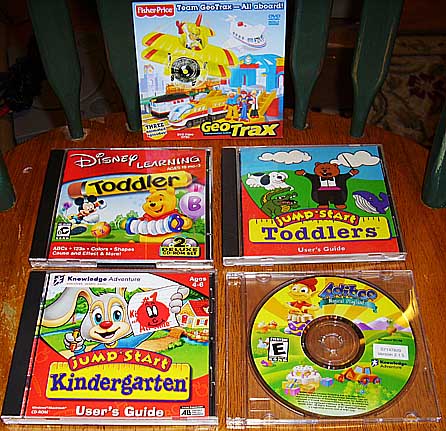
Disney Interactive learning titles based on characters such as Winnie-the-Pooh, Aladdin, The Jungle Book and Mickey Mouse.
GCompris, contains numerous activities, from computer discovery to science
Knowledge Adventure’s JumpStars and Blaster Learning System series
The learning Company’s Reader Rabbit, The Clue Finders and Zoombinis series.

Ergonomic hardware is fundamental for baby learning, where Tablet PCs  and touchscreens are preferly used instead of keyboards and computer mice. Also, a closed environment is created, to inhabilitate the use of the keyboard (excepting some combination of keys that can only be typed by and adult), taskbar and opening of other programs and screens.

Some dedicated baby and child computers can additionally parents' explicitly allowed Java programs and USB devices (that can also be used to connect to the adult's computer).